
Planting
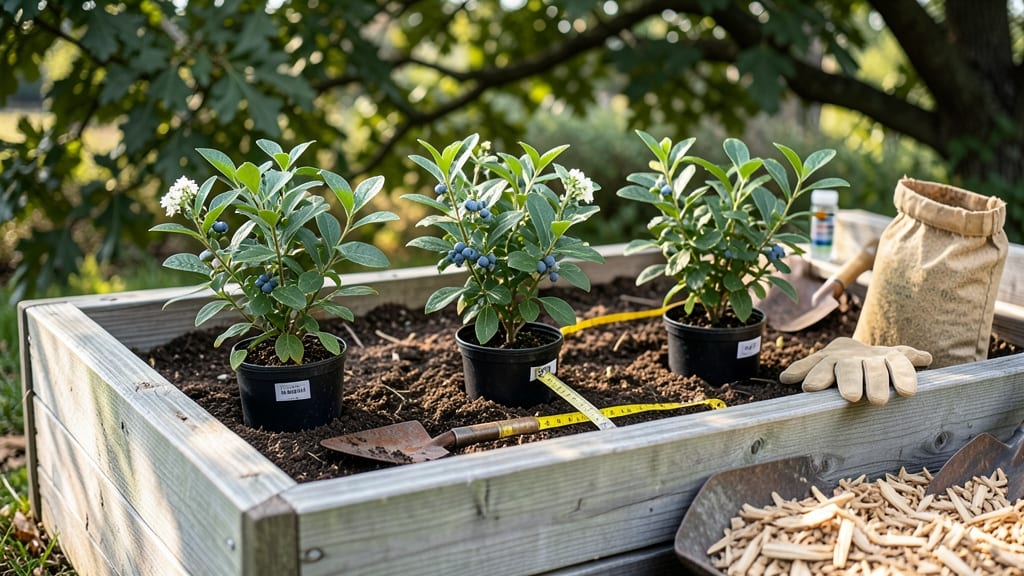
Blueberry raised bed spacing requires planting bushes 4 to 6 feet apart for dwarf varieties and 6 to 10 feet apart for standard types to ensure proper airflow, sunlight exposure, and root development for maximum berry production and plant health.
Proper spacing isn't just about fitting more plants—it's about creating an environment where each bush thrives. Dwarf varieties (like 'Top Hat' or 'Peach Sorbet') need that 4-6 foot gap to avoid shading their neighbors, while taller bushes (such as 'Duke' or 'Bluecrop') require 6-10 feet to develop strong root systems. 🌿 Without enough room, you'll see smaller berries, increased disease risk from poor airflow, and competition for water that stresses the plants.
I've found that staggered rows—planting every other bush slightly offset—can squeeze in more plants while still maintaining airflow.
Another key factor is your microclimate. If your raised beds are in a shady spot or have heavy clay soil, you might need to increase spacing by 1-2 feet to compensate.
For example, 'Patriot' blueberries, which are naturally vigorous, often need the full 10-foot spacing unless you're using a trellis system to train their growth. The goal is to balance density with plant health—crowding might give you a fuller bed now, but it'll cost you in yield and longevity.
💡 In This Article
- Why Proper Blueberry Spacing Boosts Fruit Production
- Optimal Blueberry Raised Bed Layouts by Variety
Why proper blueberry spacing boosts fruit production
Blueberry bushes thrive when given space because their growth habits and biological needs demand it. The key factor is canopy competition—when bushes grow too close, their leaves shade each other, reducing photosynthesis in the lower branches.
This creates a 30-50% drop in fruit production because the shaded areas can't support berry development. 🌱 For example, a 'Bluecrop' bush with a mature spread of 5-6 feet will struggle if planted only 4 feet apart, as its branches will tangle and compete for sunlight.
The science behind this involves root zone competition. Blueberry roots spread horizontally, typically 2-3 feet deep but extending 3-5 feet outward for dwarf varieties and up to 6 feet for standard types. When roots overlap, they compete for water and nutrients, leading to chlorosis (yellowing leaves) and stunted growth.
Proper spacing ensures each bush has its own nutrient-rich zone in the raised bed's soil mix, which is especially critical since blueberries prefer acidic soil (pH 4.5-5.5) that can become depleted quickly.
Airflow is another critical factor that proper spacing addresses. Blueberries are prone to fungal diseases like botrytis and powdery mildew, which thrive in humid, stagnant conditions. A 4-foot spacing allows air to circulate between bushes, reducing moisture buildup on leaves by 40-60% compared to crowded plantings.
I've noticed in my own gardens that well-spaced bushes also ripen more uniformly—overcrowded plants often produce berries at different maturity stages, making harvests less efficient.
Pollination efficiency improves with proper spacing too. While blueberries are self-pollinating, bees and other pollinators work more effectively when they can move freely between flowers. A 6-foot spacing for standard varieties creates clear pathways for pollinators, increasing fruit set by 15-25% compared to tight plantings.
The visual appeal also matters—well-spaced bushes create an open, airy canopy that makes harvesting easier and reduces fruit damage from branches rubbing together.
One common misconception is that closer spacing will lead to earlier fruiting. In reality, crowded bushes often delay fruiting by 1-2 years as they focus energy on competing for resources rather than producing berries.
The trade-off between immediate density and long-term productivity is clear: tighter spacing might give you a fuller bed appearance now, but proper spacing ensures a healthier, more productive garden for years to come.
Consider this real-world example: In a 4'x8' raised bed, you could fit 4 dwarf bushes spaced 4 feet apart in a square pattern, but they'd quickly outgrow the space.
By using a staggered layout with 5 feet between bushes, you maintain airflow while fitting in 3 bushes—but each produces 30% more berries annually due to reduced competition. The lesson? Quality over quantity always wins with blueberries. 💫