
Planting
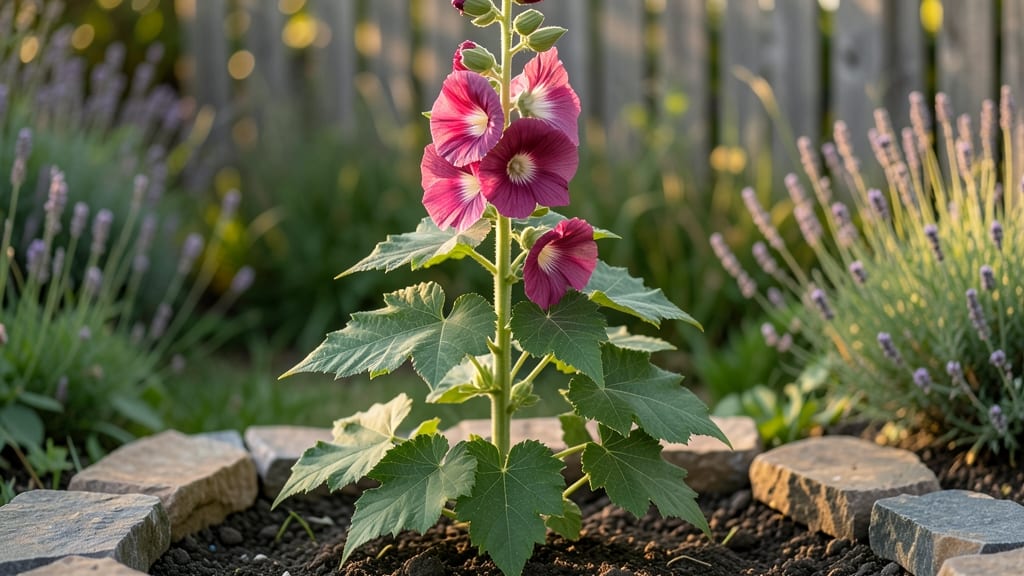
The hollyhock hardy zone spans USDA zones 3 through 9, where these plants endure winter lows down to -20°F (-29°C) once fully rooted, but younger plants need winter protection like mulch in colder regions.
The hollyhock hardy zone includes regions where these hardy perennials (or biennials) rely on deep taproots to store nutrients, helping them bounce back after frost. 🌱 In zones 3–5, I’ve seen them survive unprotected winters if the ground stays dry, but heavy snow or soggy soil can cause rot.
For extra insurance, add a thick layer of straw mulch after the first hard frost—it mimics their natural Mediterranean habitat where they evolved to handle seasonal dormancy.
What’s interesting is how their growth habit changes with climate: in warmer zones (7–9), they often bloom prolifically the first year, while in colder zones (3–5), they may wait until their second year to show their full splendor.
This delayed flowering is their survival strategy—building strong roots before investing energy in flowers.
💡 In This Article
- Hollyhock Cold Tolerance: How Perennial Varieties Survive Winter
- Best Hollyhock Varieties for Extreme Climates
Hollyhock cold tolerance: how perennial varieties survive winter
The secret to hollyhocks' hardiness lies in their deep, fibrous root system that can extend 3-5 feet below ground. This extensive network stores carbohydrates during dormancy, fueling regrowth when temperatures rise above 50°F (10°C) in spring.
Unlike shallow-rooted annuals, hollyhocks tap into soil moisture and nutrients deep underground, making them far more resilient to freeze-thaw cycles. 🌱 The root crown (where stems meet roots) contains meristematic tissue that remains protected by insulating soil, even when surface temperatures drop below -10°F (-23°C).
Hollyhocks employ a two-phase survival strategy during winter: first, they undergo dormancy when nighttime temperatures consistently fall below 45°F (7°C) for several weeks, halting active growth. Then, they enter a state of cold acclimation, where cell membranes adjust to prevent ice crystal formation in their tissues.
This process peaks when daytime highs stay below 32°F (0°C) for 2-3 weeks. What's fascinating is how their leaves turn brown and crispy—not because they're dead, but because the plant redirects all energy to preserving its root system and crown.
For gardeners in zones 3-5, the critical threshold is -20°F (-29°C), which is the absolute minimum hollyhocks can tolerate once fully established. However, young plants (under 1 year old) are far more vulnerable, with their roots not yet deep enough to access protected soil layers.
This is why I always recommend mulching with 4-6 inches of straw or shredded leaves after the first hard frost—it adds 10-15°F of insulation to the root zone. The mulch also prevents soil temperature fluctuations that can stress the plant's meristematic tissues.
There's an important distinction between biennial and perennial hollyhocks when it comes to cold tolerance. Biennial varieties (like most Alcea rosea cultivars) complete their life cycle in 2 years, storing energy in their first year to produce flowers in their second year before dying.
These types are slightly less cold-hardy than true perennials because they haven't had as much time to develop extensive root systems.
Perennial varieties, on the other hand, continue growing each year, building deeper roots that provide better winter protection. 🌿 This is why established perennial hollyhocks often survive winters in zone 3 with minimal protection, while biennials may need extra care.
The timing of frost also matters significantly. Hollyhocks can handle light frosts (above 28°F (-2°C)) even when in active growth, but prolonged exposure to below 20°F (-7°C) while flowering can damage their delicate blooms.
What most gardeners don't realize is that hollyhocks often produce their second flush of flowers in late summer, which coincides with the first autumn frosts. This timing makes them particularly vulnerable to early cold snaps in zones 6-9, where summer nights can suddenly drop below freezing.
One practical tip I've learned from growing hollyhocks in zone 4 is to avoid pruning back dead foliage until late March or early April, when daytime temperatures consistently reach 50°F (10°C).
The old stems provide additional insulation for the crown, and removing them too early can expose the meristematic tissue to late frosts. This delayed pruning has helped my hollyhocks survive winters with -30°F (-34°C) temperatures that would otherwise be lethal to young plants. 💫