
Planting
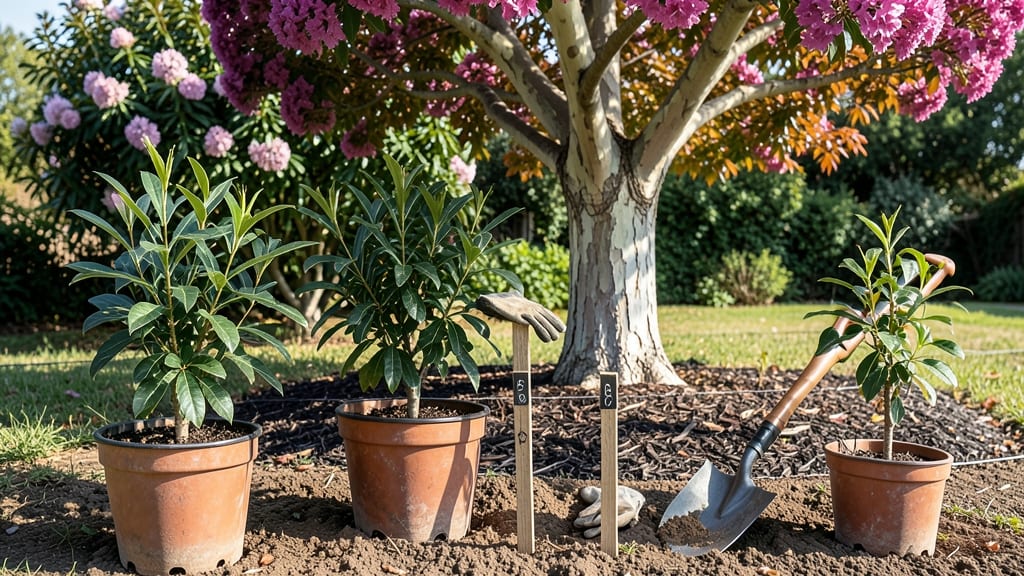
Crepe myrtles should be planted 6 to 15 feet apart to accommodate their mature size and sunlight needs—dwarf varieties thrive at 6–8 feet spacing, while larger standard trees need 10–15 feet for optimal growth and airflow.
Proper spacing prevents overcrowding, which can lead to disease or stunted growth. 🌿 The key is matching your variety's mature width—dwarf types like 'Arapaho' stay compact, while 'Natchez' can spread 15 feet wide.
I always check the tag for predicted height and width before planting, as this determines both the spacing and the long-term aesthetic of your landscape.
For full sun exposure, which crepe myrtles love, maintain at least 10 feet between standard trees to ensure each gets 6+ hours of direct sunlight daily. In partial shade or windy areas, you might increase spacing to 12–15 feet to give roots room to establish without competing.
This also makes maintenance easier—pruning and mulching become far more manageable when trees aren't packed too closely.
💡 In This Article
- Crepe Myrtle Spacing Factors: Size, Variety, and Sunlight Needs
- Planting Layout Tips for Crepe Myrtles in Landscapes
Crepe myrtle spacing factors: size, variety, and sunlight needs
Crepe myrtles grow at dramatically different rates based on their variety, which directly impacts spacing needs. Dwarf varieties like 'Arapaho' or 'Tonto' typically mature at 6–8 feet tall with a spread of 4–6 feet, making 6–8 feet of spacing ideal.
These compact trees develop slowly—about 1–2 feet per year—so they won’t outgrow their space quickly. In contrast, standard varieties such as 'Natchez' or 'Muskogee' can reach 20–30 feet tall with a 12–15 foot spread, requiring 10–15 feet between plants to prevent root competition and disease spread.
The relationship between sunlight exposure and spacing is critical because crepe myrtles thrive in full sun (6+ hours daily).
When planted too closely in sunny areas, branches from neighboring trees can shade each other, reducing flower production—their signature feature. 🌞 In partial shade or windy locations, increase spacing to 12–15 feet to allow roots to establish without competing for nutrients.
Root spread often extends beyond the canopy, so dig a hole twice as wide as the root ball to accommodate this growth.
Growth rate varies by variety, with some like 'Sioux' growing 2–3 feet per year while others like 'Catawba' remain slower. This means faster-growing types need more initial spacing to prevent future overcrowding.
I’ve seen landscapes where crepe myrtles were planted too close—after just 5 years, the trees were touching, leading to fungal issues and reduced blooms. Always verify the mature size on the nursery tag before planting.
Sunlight also affects how crepe myrtles allocate energy. Trees in full sun direct more resources to flowering and upward growth, while those in shade may grow wider but produce fewer blooms.
This is why spacing calculations should factor in both the tree’s mature width and the sunlight conditions of your yard. For example, a 15-foot-wide 'Natchez' needs 10–15 feet of space in full sun but could stretch to 18 feet in partial shade.
Consider the root system too—crepe myrtles develop extensive lateral roots that spread outward. A general rule is to space trees 1.5 times their mature width apart. For a 10-foot-wide tree, that’s 15 feet of spacing.
This prevents root girdling, where roots encircle each other and strangle growth. Mulching 3–4 inches deep around the base (but not touching the trunk) helps manage root competition in tight spaces.
One common mistake is assuming all crepe myrtles have the same spacing needs. For instance, the weeping variety 'Prairie Moon' has a 12-foot spread but only grows 8–10 feet tall, so it needs 8–10 feet of space despite its wide canopy.
Always match spacing to the tree’s horizontal growth pattern, not just its height. 🌿