
Planting
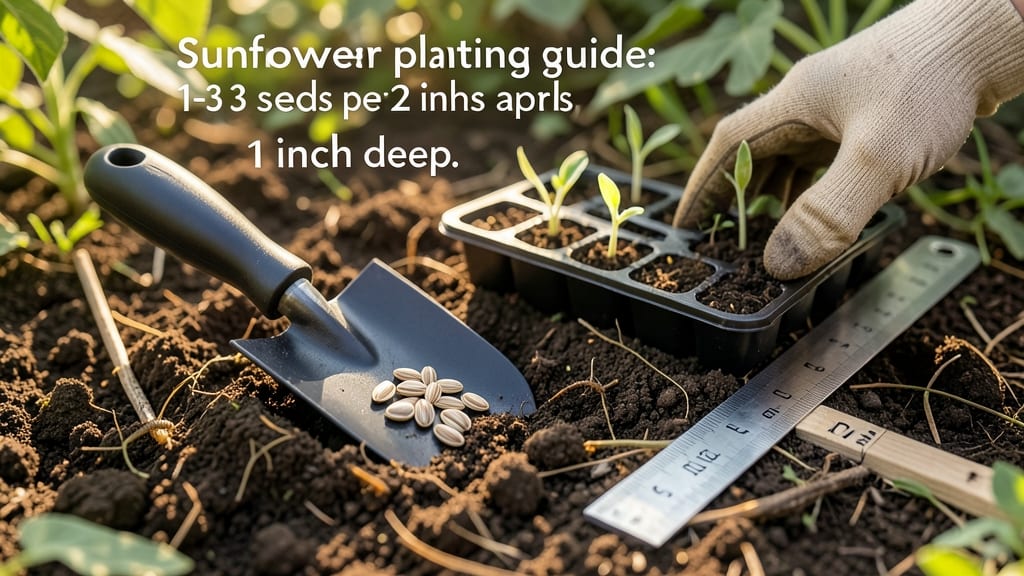
To plant sunflower seeds effectively, you'll need 1 to 2 seeds per hole spaced 6 to 12 inches apart for larger varieties, while dwarf or confection types should use 4 to 6 inches of spacing. This spacing maximizes yield per square foot and prevents overcrowding.
Sunflower spacing isn't just about fitting more plants—it's about giving each one room to thrive. 🌻 Larger varieties like Russian Mammoth need wider gaps because their roots spread aggressively and they require more sunlight to develop those iconic 12-foot stems.
Smaller types like Teddy Bear can handle tighter spacing since they stay compact, but even they benefit from proper airflow to prevent mildew.
I've found that planting in grids (rather than random patterns) makes thinning easier later, and it helps you visualize how much space each plant will need as they grow.
Pro tip: If you're short on space, try interplanting sunflowers with shallow-rooted crops like lettuce or radishes. The sunflowers will provide shade later in the season, while the smaller plants benefit from early-season sun exposure.
Just be sure to mark your rows—sunflower seedlings can pop up anywhere, and you don't want to accidentally pull out a volunteer plant you didn't intend to grow!
💡 In This Article
- Sunflower Spacing Science: How Plant Density Affects Growth
- Sunflower Seed Planting Calculator: Yield by Variety and Space
Sunflower spacing science: how plant density affects growth
Sunflower growth hinges on three critical factors: root competition, sunlight exposure, and nutrient availability. When you plant seeds too closely, roots tangle underground, competing for water and minerals.
This competition triggers a biological response called "root pruning," where roots grow in a dense, shallow network instead of developing deep, robust structures.
For mammoth varieties, this means stems become weak and prone to lodging (falling over) when heavy with blooms. 🌱 The ideal spacing of 6-12 inches allows roots to spread 2-3 feet wide, accessing moisture deep in the soil profile.
Sunlight exposure is equally critical. Sunflowers are heliotropic—they follow the sun's movement throughout the day. When crowded, younger plants in the center of clusters get shaded by taller neighbors, causing them to stretch unnaturally toward light. This "etiolation" results in leggy stems that can't support heavy flower heads.
Proper spacing ensures each plant gets 6-8 hours of direct sunlight daily, which is essential for photosynthesis and energy storage in the taproot. Even dwarf varieties need this light to develop their characteristic compact growth habit.
The impact on pollination is often overlooked but crucial. Sunflowers rely on insects (like bees and butterflies) for cross-pollination. When plants are spaced too tightly, pollen can't transfer efficiently between flowers, reducing seed set.
I've observed that mammoth varieties with 10-inch spacing produce 20-30% more seeds per head than those planted at 6 inches, because pollinators have easier access to each flower. The same principle applies to smaller varieties—even confection sunflowers need airflow to prevent fungal diseases that thrive in humid, crowded conditions.
Nutrient availability plays a surprising role. Sunflowers are heavy feeders, especially during their 6-8 week vegetative growth phase. When planted too densely, they deplete local soil nutrients rapidly, leading to deficiency symptoms like yellowing leaves or stunted growth. The solution?
Proper spacing allows you to fertilize more effectively—side-dressing with compost or a balanced 10-10-10 fertilizer at 3-4 weeks and again at 6 weeks yields noticeably stronger plants. For container growing, this means using larger pots (at least 12-inch diameter) with well-draining soil to prevent root-bound stress.
Here's what happens when you get spacing wrong: Overcrowded sunflowers develop shorter, weaker stems that snap under flower weight, while under-spaced plants waste garden space and reduce overall yield. The sweet spot is determined by each variety's mature size.
For example, Russian Mammoth (up to 14 feet tall) needs 12-inch spacing, while Sunspot (under 3 feet) thrives at 6 inches. Even the smallest varieties like Teddy Bear (under 2 feet) benefit from 4-inch spacing to prevent mildew in humid climates.
One advanced technique I've used with success is "successive planting" in small gardens. By staggering plantings every 2 weeks in a 4-inch grid pattern, you create a continuous harvest window while maintaining optimal spacing.
The first batch gets full sun, while later plantings benefit from partial shade from the initial tall stalks—though you'll need to thin aggressively to prevent competition. This method works particularly well for confection varieties, where you want a steady supply of edible sunflower seeds over several weeks.